
Property Condition Report (PCR) | Property Condition Assessment (PCA)

Property Condition Assessment (PCA’s)

Due Diligence – Property Condition Report | Property Condition Assessment (PCA’s)

Criterium-Hardy Engineers’ Property Condition Report, also called a Property Condition Assessment, is a comprehensive due diligence service designed to meet the objectives of your real estate portfolio, whether you represent a commercial real estate owner or manager, institutional investor or investment banker. Criterium-Hardy Engineers works with clients to understand those objectives, to develop scopes and formats to serve your needs, and to deliver comprehensive and high quality property condition reports.

To that end, our Property Condition Assessment report contains information about the structure and its components vital to investment and finance decision making. Further, the report provides appropriate due diligence for the real estate transaction with regard to a property’s physical condition.  In addition, our reports comply with industry standards such as those of Standard and Poor and ASTM 2018. This said, customized or abbreviated reports and formats for special needs or very large and time sensitive assignments have also been developed to suit your special needs or time constraints.

Furthermore, we realize that each client has a slightly different perspective that is often reflected in what they call the report.

  • The investment community uses a Property Condition Assessment to budget reserves and sometimes negotiate with the seller.
  • The government may use a Project Capital Needs Assessment to preserve the quality of housing over the term.
  • Corporate owners need a Capital Needs Assessment to develop budgets and streamline operations.
  • Community Associations require a Reserve Study to be able to properly assess owners for non-annual costs.

In order to meet varying client needs, Criterium-Hardy Engineers does not specialize in any one type of property condition assessment. Rather, we bring our broad expertise to each assignment to ensure the best possible outcome.
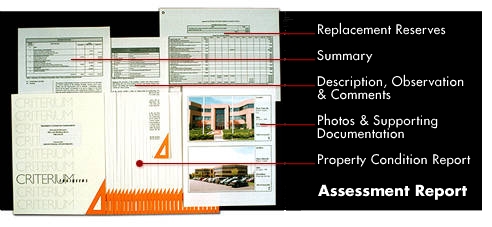
Criterium-Hardy Engineers Property Condition Assessment report featuring sections on Replacement Reserves, Summary, Description, Observation & Comments, Photos & Supporting Documentation, and a Property Condition Report layout.

For example, in our standard Property Condition Assessment report, we evaluate the:

  • Topography
  • Drainage
  • Paving & Curbing
  • Flatwork
  • Landscaping
  • Structural Components (substructure & superstructure)
  • Exterior
  • Roofs
  • Reserves
  • Electrical
  • HVAC
  • Vertical Transportation
  • Security
  • Interior
  • Fire Safety
  • Amenities
  • Accessibility (ADA) Regulatory Compliance
  • Maintenance
  • Plumbing

To summarize, our PCA investigation is designed to address the unique concerns and risk tolerance of our clients. We provide a list of current deficiencies and areas of deferred maintenance along with the cost to cure these deficiencies. At the end of our report is a table of capital reserve requirements.  To learn more about what is included in our standard property condition report, please review our detailed Property Condition Assessment scope.

CONTACT US
REQUEST A PCA PROPOSAL

When a PCA Is Typically Required

Property Condition Assessments are commonly commissioned during:

  • Commercial property acquisitions

  • Loan origination or refinancing

  • Portfolio evaluations

  • Ownership transitions

  • Long-term capital planning cycles

Many lenders require an ASTM-compliant Property Condition Report before approving financing.

Key Benefits of a Professional PCA

  • Independent, engineer-led evaluation

  • Clear documentation of building conditions

  • Capital reserve and cost projections

  • Improved negotiating leverage

  • Reduced exposure to unforeseen repairs

Our Property Condition Assessment Process

  1. Document Review
    Review available drawings, maintenance records, and prior reports.

  2. On-Site Property Inspection
    Visual inspection of major building systems, including:

    • Structural components

    • Roofing and envelope

    • HVAC, electrical, and plumbing systems

    • Life safety and accessibility features

  3. Deficiency Identification
    Identification of observed deficiencies, deferred maintenance items, and safety concerns.

  4. Cost Estimates & Capital Planning
    Development of repair and replacement cost estimates, including short-term and long-term capital needs.

  5. Property Condition Report Delivery
    Issuance of a clear, lender-ready PCR aligned with ASTM E2018 PCA standards.

Why Choose Our Engineering-Led PCA Services

Unlike checklist-based inspections, our Property Condition Assessments are performed by licensed professional engineers with extensive commercial building experience. This ensures:

  • Technical accuracy

  • Defensible findings

  • Reports trusted by lenders and institutional investors

We integrate engineering judgment with real-world cost data to deliver practical, actionable PCA reports.

Request a Property Condition Assessment

If you need a Property Condition Assessment or Property Condition Report for due diligence, financing, or capital planning, contact our engineering team today to discuss your property and timeline.

CONTACT US
REQUEST A PCA PROPOSAL
When should I hire a structural engineer instead of a home inspector?
You should hire a structural engineer when you have concerns about the structural integrity of a home, such as foundation movement, significant cracks, sagging floors, or load-bearing wall modifications. Unlike home inspectors, structural engineers are licensed to evaluate structural systems and provide engineering opinions and repair recommendations.
What happens during a residential structural engineering evaluation?
A residential structural engineering evaluation typically includes a visual inspection of the foundation, framing, floors, walls, and roof structure. The engineer assesses observed conditions, identifies potential structural issues, and determines whether repairs or further investigation are needed.
Can a structural engineer tell me if a crack is serious?
Yes. A structural engineer can evaluate the size, location, and pattern of cracks to determine whether they are cosmetic or indicative of a structural problem. The evaluation helps identify the cause of the cracking and whether corrective action is required.
Do I need a structural engineer to remove a wall?
If the wall may be load-bearing, a structural engineer should evaluate it before removal. The engineer can determine whether the wall supports the structure and, if so, design appropriate framing or beam solutions to maintain structural safety.
Will I receive a stamped structural engineering report?
When required, a licensed professional engineer can provide a signed and stamped report or letter documenting the findings and recommendations from the evaluation. This is often used for permitting, contractor coordination, or real estate transactions.
How much does a residential structural engineering evaluation cost?
The cost of a residential structural engineering evaluation varies based on the scope, complexity, and location of the property. Most evaluations are a one-time professional fee and provide significant value by identifying potential structural risks early.
Can you coordinate with my contractor or architect?
Yes. Structural engineers commonly coordinate with contractors, architects, and other design professionals to clarify findings, review repair approaches, and support project execution.